I feel like math is always the forgotten subject when we think of reading and literacy. However, understanding the skills needed to complete math all boils down to reading and comprehending what the problem is stating. The article, “A Literature Review on Disciplinary Literacy: How Do Secondary Teachers Apprentice Students into Mathematical Literacy?”, points out a great idea stating, “Although there are fewer words per page in math than in other disciplines, each word carries meaning that must be unpacked carefully to enable understanding” (Hillman, 2013, p.401). Therefore, we as future teachers need to see the impact disciplinary literacy has in math. I thought the tools mentioned in the videos and in the article I read were extremely beneficial for helping teachers implement disciplinary literacy in a math course.
The first video explains a process called, “List, Group, Label”. I had never heard of this before watching the video, however, I thought it was a great method. What I like about it was that it could be carried out at any level. I feel even high schoolers could use this method when discussing difficult content. The first step is brainstorm a list of words that fall under the given category. This can be done collaboratively or individually. Then students group the words into subcategories. Lastly, they label the groupings with descriptive titles. This entire process allows the students to grow their knowledge on the subject. So, let’s think of math. A teacher could start off by giving the category of fractions. Then students begin to throw out (list) words such as numerator, ½, percent, dominator, ¾, decimal, etc. Then, in groups, you could have the students group these terms. An example might look like:
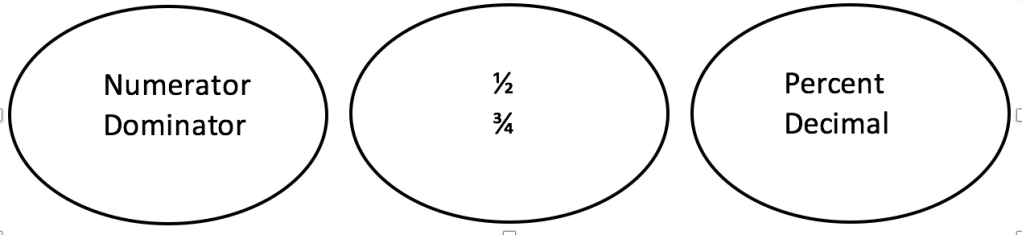
After the students group them, they would need to label the groups. For the first block, they might label it “parts of a fraction”. Then the second one would be “examples of fractions” and the last group would be “other ways to represent fractions”. By having students do this method, they can think like the experts, which in this case are mathematicians. They are breaking down the content so they can fully understand and use the terms correctly. This method gives a definition to terms in a new light instead of just the teacher presenting the information. Here, the students are coming up with their own thoughts and groups of how they are understanding the material.
If we could get students to understand this is a routine they should carry out every time they are presented with a new math problem or concept, they would be well on their way to understanding math better. Each student needs to be presented with the idea that they are mathematicians. As a teacher, you should make it known that they are very capable of achieving that, but to do so, they must follow the protocol that makes someone a mathematician. That means following how the community interacts and using the correct terms when speaking and carrying out math. When talking about what is mathematical Discourse, the article brings to light that, “some routines include categorizing, recognizing when problems require similar procedures, calculating based on operational properties, and deductive reasoning. Routines define reasoning and acceptable argumentation” (Hillman, 2013, p.402). I believe that points right to the method of “List, Group, Label”. It may be at a lower level, but it is allowing the students to see patterns of math by having the group concepts together and see what each term means for the whole.
After students do this activity there could be great discussion of how one see’s the terms carried out. So, to continue the fractions example, after the students have labeled all their groups and shared with the class, the teacher could put an equation on the board. There, the students could label the numerator and dominator and they could say whether two fractions are equal or not and provide an explanation. In that explanation, they might reference that when they changed the fractions into decimals they noticed that it gave them two different results or the same result.
This idea of using what the students know about math is seen in the second video where the teacher is questioning the students’ thoughts on whether the two equations are equal. By providing such a problem, the teacher is allowing the students to play with math, while making sure they are using correct terms and abiding by the right rules. The students collaborate with each other to try to come up with the right answer by using the language used by mathematicians. Those terms could be words like “addition”, “equals”, “divisor”, etc. This is exactly disciplinary literacy. This is how simple it is to incorporate into your class, even math. No one is saying that you must include these methods into one lesson. It might be a process for the students to grasp, especially depending on their age. Maybe one lesson is just generating the “List, Group, Label” and discussing why they did that and how that sets them up for later. Then the next lesson could be giving the equation or word problem and having students talk about it using proper language.
So, take a deep breath. Disciplinary literacy in math is just as simple as it is in English or History or any other subject. All it takes is a confident teacher who is willing to help their students achieve “expert” status. It is like a super power given to teacher. Go out there and help create mathematicians!! 🙂
References:
Video 2: https://tedd.org/?tedd_activity=truefalse-equations
Hillman, A. M. (2013). A literature review on disciplinary literacy: How do secondary teachers apprentice students into mathematical literacy? Journal of Adolescent & Adult Literacy, 57(5), 397-406


 Teaching: The Art of Being a Forever Learner
Love this! Bringing up the fact that math is a forgotten subject when it comes to disciplinary literacy is definitely important, especially since we’re in our math block. How perfect; disciplinary literacy and math content in one semester! Taking the example from the Reading Rockets video and turning it into a math example for math terms really helped me visualize even further what disciplinary literacy would look like in a math class for this instance. Talking about math in this field is important and, I’m sure you feel the same when I say, I am intimidated with the task of implementing disciplinary literacy in a math classroom.
Do you think this method you mention as the way to create mathematicians is just the foundation? For me, I think there are more than just this method, but the List Group Label method is a perfect way to break down and unpack math terms as a start. I would really love to hear more ideas and methods for literacy in math!
LikeLike
The list group label method was an excellent method to teaching in my opinion. I thought the first teacher did a good job of letting the students take control of their own learning, whereas the second teacher dominated the discussion, rather than letting her students work in groups. Maybe there are other factors behind her motivation, but it just did not seem as effective. Also, the second video seems a bit dated. It just looked old and the approach seemed to be out of touch with the inquiry based learning. Your picture was really great, it showed a good representation of what you were explaining. Fractions are a pain in the butt, and it seems to be difficult for students to grasp. I do not know what your thoughts are on the True/False method that the second teacher used, but I found it to be riddled with flaws. The teacher used a problem that could have easily misconstrued to be “True”, when obviously it was false. Why not have the students break up into partners or groups and use the “Think, Pair, Share” method. Your post was also extremely in depth. I thought I was reading a Shakespearian piece of literature, full of deeper meaning expressions and an explanation that seemed to be quite intellectual. Overall, this was a solid post. I aspire to model my own post over yours. Kudos.
LikeLike
I found your blog very compelling. Although I do not want to be a math teacher, I know that if I teach elementary school, math may very well be a content area I teach. With this being said, I am an ELA junky. I love ELA and think that in order to solve a math problem, read a primary source, or understand the directions of a science experiment, you must be able to read. Reading, in my opinion, is essential to all content areas. Without reading, all other subjects would be irrelevant. You always see reading in history, but do you ever really see math?
With this being said, I think disciplinary literacy is very important – to be able to incorporate reading, listening, writing, and speaking skills across all disciplines. I think you would agree with me, considering you found both videos effective, as I did, too. I’m specifically interested on your example of “List, Group, Label” in a math classroom. Your incorporation of math vocabulary is essential to math – math is not just about the numbers, but the words, too! But, my confusion arises when you state that “it may be at a lower level.” I agree that this method would be very useful in an elementary classroom. In elementary schools, we are looking at basics. We are trying to get children to understand what the difference is between a numerator and a percent. What the difference is between ½ and a decimal. With this, I see your suggestion that this is crucial in a low-grade level. But the question arises – how can you incorporate this into a middle school or high school classroom? When the basics are already assumed as being known? By middle school/high school, students know how to group words and label categories. So, do you think this “List, Group, Label” could be used at a higher level? Or is it too basic of a skill?
Obviously disciplinary literacy can be implemented across all grade levels, as we have read about examples and discussed them in class. It is a higher level of thinking. The teacher guides the discussion, but the students are attempting to lead it. In my opinion, I believe the basics of the second video are more likely to be implemented in a higher-level math classroom. A calculus problem could be presented on the board – is this true or false? This is a more complex problem, where students could possess the same thinking and discussing they did in the 4th grade math class. The 2nd video seems to be more widespread across the grade levels. True or false? 2+2=4+6? Do the two graphs have the same slope? I believe, in my opinion, that this example of disciplinary literacy is more crucial and effective in a math setting – even at a higher level.
LikeLike
I agree with you in the sense that mathematics is a subject that does not necessarily have “reading and writing” written all over it. However, as you mentioned throughout your blog, reading and writing does have a very important purpose in mathematics, and that purpose is to guide students to think like a mathematician and to help them understand the roots of the content, hence disciplinary literacy. I appreciate your example of the strategy of the “List, Group, Label” that teachers can use to introduce the content of a lesson. I think that this strategy has a lot of potential if it is done in a meaningful way. I love your example of doing this strategy for fractions and how you thoroughly explained how you would facilitate the instruction and gave anticipated student answers to fully explain the strategy. However, in what context would you use this strategy in the classroom? Would it be an introduction to when then students are learning about fractions for the very first time? Or would it be part of lesson where the students already have background knowledge on fractions and perhaps this lesson is taking their thinking to a new level like adding and subtracting fractions? I think that the student’s background knowledge is very important to consider when using the “List, Group, Label” strategy because if you give the category of “fractions” and that is the first time they are being introduced to fractions, then they could not complete the activity due to lack of background knowledge. I do agree that this strategy can be a great starting point in a lesson to help the students make sense of the key terms on their own while also helping them to create patterns and connect concepts together.
LikeLike