As future educators, we are being taught how to teach with
the latest and greatest models possible.
Since I was in school, there has been a large shift in how one teaches
mathematics. The focus used to be about
having students know how to use the algorithms and ace a test. Now, teachers are encouraged to develop deep
understanding of the mathematical concepts with their students. The algorithm should be the last thing the
students learn and they should almost come up with it on their own. In addition to that, the article, “Using Transactional
Reading Strategies to Support Sense-making and Discussion in Mathematics Classroom:
An Exploratory Study”, states, “the call now is for curricula that focus on
developing reasoning, communication, and problem-solving abilities (NCTM, 1989)
as well as on promoting understanding of the “big ideas” within
mathematics (Steen, 1990) and building realistic conceptions of mathematics as
a discipline (Borasi, 1992)” (Borasi, Siegel, Fonzi, & Smith, 1998). This whole new development is a way to end
the, “why are we learning this”, mathematics.
We need to provide a reason and create an understanding of math.
As we see this transition in teaching math, the article also brings up how we read mathematics. We can no longer just focus on understanding math terms and the technical writing that it can be sometimes. Now, we must have students read math to understand math. The lesson should not be on defining terms and braking apart the sentences for key words. The article brings up when theorist Rosenblatt uses, “the term transaction to call attention to the way in which the reader and the text shape and are shaped by each other during the reading event. By doing so, she turned the spotlight on readers’ experiences while reading what they felt, thought, wondered, questioned-to understand their transactions with texts” (Borasi, Siegel, Fonzi, & Smith, 1998). She believes that students should read the math reflecting on it on what they are understand, what they can pull from it, and what it means for the problem. This once again puts the students in the driver’s seat and allows them to reason and understand mathematics.
Borasi, R., Siegel, M., Fonzi, J., & Smith, C. F. (1998). Using transactional reading strategies to support sense-making and discussion in mathematics classrooms: An exploratory study.Journal for Research in Mathematics Education, 29(3), 275-305
This week for class I had to fill out a graphic organizer after reading the research report named, “Religious Literacies in a Secular Literacy Classroom” by Allison Skerrett. Why I am talking about simple homework I had to do? Valid question, however, I think it brings up the point that sometimes as college students we need to take a step back and make sure we understand the basics. This homework assignment was quite simple and was a search and find for the important information. Yet, it opened my eyes even more to a topic that I do not have much background in, which is educational research. By having me look for specific material within the report, I could better understand the set up and why it was in the order that it was in. By giving me this task, I, a college senior and aspiring teacher, could fully grasp Skerrett’s methods and research process. There was background information of her research, the environment in which she was observing, interviews of students and teachers, and any other additionally research she came across. After completing the worksheet, I reflected on the task and realized that these simple procedures are important for students. Sometimes, even the smartest students need a check-in to make sure they are understanding the material. I think too often as college students we do not get the opportunity to think of information in a basic way and we lose the reason why we are talking about something. I believe this can also happen in middle school as well. At this point we are pushing students to take topics they know and understand them in a new lens. However, it is important to review the basics before just jumping into the deep, philosophical end. I know in this blog I do not really discuss the content of the research report, but I think this week is vital time to reflect on my own learning. I feel like I do a lot of thinking about what I read or write in class, however, sometimes I do not always reflect on what I am producing. This week in was a graphic organizer. Simple, yet it incredibly important to remember that all students, even the advanced ones, need to go back to basics of their learning.
Skerrett, A. (2014). Religious literacies in a secular literacy classroom. Reading Research Quarterly, 49(2), 233-250
As I dive into my research on
mathematical education, I notice there are several individuals within this same
community. People are constantly trying
to figure out how to teach math better.
Why? I believe it is because math
is the subject students struggle with the most.
There is something about having to get a right answer and following a
process that students struggle to adhere.
Therefore, as educators, we are trying to perfect a system where
students can learn math and be successful in it. As I read the articles for this week and
watched a video on teaching math, I see a similar pattern of how research is
being conducted and used in the field.
In one article I read, titled, “Analysis of Expert Readers in Three Disciplines: History, Mathematics, and Chemistry”, they discuss their study in length using outside resources and personal interviews they conducted. They structure their paper by first explaining the purpose of this whole study which states, “The purpose of this article is to describe educationally relevant differences in literacy use among three subject-matter disciplines—history, chemistry, and mathematics. These analyses were drawn from an investigation of the teaching of disciplinary literacy in high schools funded by the Carnegie Corporation” (Shanahan, et al., 2011, p.394). From here, the reader not only gains the purpose of this article, but also learns how the information was gathered. This is important for credibility and understanding of the entire article.
As the article progresses, it explains why they are conducting this study. This is under the “background” section. For example, the study states, “teachers of science, math, and history often do not know how to support their students’ reading in the disciplines and often avoid the use of text, just telling students what they want them to know” (Shanahan, et al., 2011, p.395). This clearly supports the purpose of this article which is to break down literacy in each of the subjects. From here, the article breaks down research that has been conducted on it and then results from the study. This organization is common amongst other research I have seen.
The video I watched was another form of research. However, to me, it seemed like it was just part of the research. It was clear that the teacher in the video had learned about the topic called “Number Talk”. After explaining to her students what Number Talk entails, she then carries out the procedure. This is almost her conducting her own research to see if this method is effective. This was a great video to watch because you could see her reflecting in the video as well as I could reflect on the video to see if this method is effective.
Each part of the research process is important and worth noting. As I continue to do research and write about effective teaching practices, I hope to implement these research strategies.
References:
Shanahan, C., Shanahan, T., & Misischia, C. (2011). Analysis of expert readers in three disciplines: History, mathematics, and chemistry. Journal of Literacy Research, 43(4), 393-429.Wimmer, J. J., Siebert, D., & Draper, R. (2017). Digital mathematics literacies. Journal of Adolescent & Adult Literacy, 60(5), 577-580
I feel like math is always the
forgotten subject when we think of reading and literacy. However, understanding the skills needed to
complete math all boils down to reading and comprehending what the problem is
stating. The article, “A Literature
Review on Disciplinary Literacy: How Do Secondary Teachers Apprentice Students into
Mathematical Literacy?”, points out a great idea stating, “Although there are fewer
words per page in math than in other disciplines, each word carries meaning
that must be unpacked carefully to enable understanding” (Hillman, 2013, p.401). Therefore, we as future teachers need to see
the impact disciplinary literacy has in math.
I thought the tools mentioned in the videos and in the article I read
were extremely beneficial for helping teachers implement disciplinary literacy
in a math course.
The
first video explains a process called, “List, Group, Label”. I had never heard of this before watching the
video, however, I thought it was a great method. What I like about it was that it could be
carried out at any level. I feel even
high schoolers could use this method when discussing difficult content. The first step is brainstorm a list of words
that fall under the given category. This
can be done collaboratively or individually.
Then students group the words into subcategories. Lastly, they label the groupings with
descriptive titles. This entire process
allows the students to grow their knowledge on the subject. So, let’s think of math. A teacher could start off by giving the
category of fractions. Then students
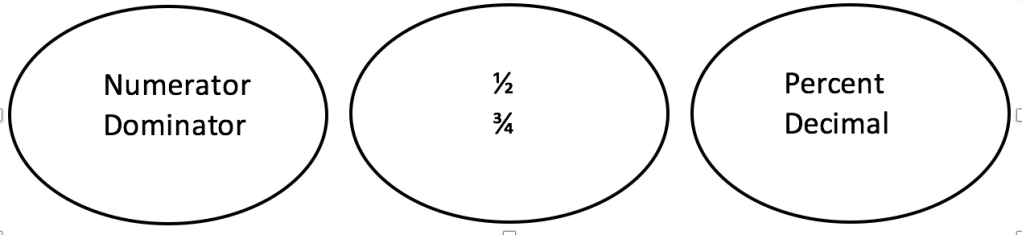
begin to throw out (list) words such as numerator, ½, percent, dominator, ¾,
decimal, etc. Then, in groups, you
could have the students group these terms.
An example might look like:
After the students group them, they would need to label the
groups. For the first block, they might
label it “parts of a fraction”.
Then the second one would be “examples of fractions” and the last
group would be “other ways to represent fractions”. By having students do this method, they can
think like the experts, which in this case are mathematicians. They are breaking down the content so they
can fully understand and use the terms correctly. This method gives a definition to terms in a
new light instead of just the teacher presenting the information. Here, the students are coming up with their
own thoughts and groups of how they are understanding the material.
If we could get students to understand this is a routine they should carry out every time they are presented with a new math problem or concept, they would be well on their way to understanding math better. Each student needs to be presented with the idea that they are mathematicians. As a teacher, you should make it known that they are very capable of achieving that, but to do so, they must follow the protocol that makes someone a mathematician. That means following how the community interacts and using the correct terms when speaking and carrying out math. When talking about what is mathematical Discourse, the article brings to light that, “some routines include categorizing, recognizing when problems require similar procedures, calculating based on operational properties, and deductive reasoning. Routines define reasoning and acceptable argumentation” (Hillman, 2013, p.402). I believe that points right to the method of “List, Group, Label”. It may be at a lower level, but it is allowing the students to see patterns of math by having the group concepts together and see what each term means for the whole.
After students do this activity there could be great discussion of how one see’s the terms carried out. So, to continue the fractions example, after the students have labeled all their groups and shared with the class, the teacher could put an equation on the board. There, the students could label the numerator and dominator and they could say whether two fractions are equal or not and provide an explanation. In that explanation, they might reference that when they changed the fractions into decimals they noticed that it gave them two different results or the same result.
This idea of using what the
students know about math is seen in the second video where the teacher is
questioning the students’ thoughts on whether the two equations are equal. By providing such a problem, the teacher is
allowing the students to play with math, while making sure they are using
correct terms and abiding by the right rules.
The students collaborate with each other to try to come up with the
right answer by using the language used by mathematicians. Those terms could be words like “addition”, “equals”,
“divisor”, etc. This is exactly disciplinary
literacy. This is how simple it is to
incorporate into your class, even math. No
one is saying that you must include these methods into one lesson. It might be a process for the students to
grasp, especially depending on their age.
Maybe one lesson is just generating the “List, Group, Label” and
discussing why they did that and how that sets them up for later. Then the next lesson could be giving the
equation or word problem and having students talk about it using proper
language.
So, take a deep breath. Disciplinary literacy in math is just as simple as it is in English or History or any other subject. All it takes is a confident teacher who is willing to help their students achieve “expert” status. It is like a super power given to teacher. Go out there and help create mathematicians!! 🙂
Hillman, A. M. (2013). A literature review on disciplinary literacy: How do secondary teachers apprentice students into mathematical literacy? Journal of Adolescent & Adult Literacy, 57(5), 397-406
That is exactly what this blog has been…progress. We first explored the topic of what disciplinary literacy is and then how to implement it in the classroom. Now it is time to talk about the where and when. Where do teachers incorporate disciplinary literacy? When do teachers start? What age group should disciplinary literacy begin?
Well great news! Disciplinary literacy should be a part of
elementary education, just as much as it is in higher grades. As being a pre-service middle school teacher,
it is important to understand how disciplinary literacy looks and works for the
younger end of our certification. The
article, “Does Disciplinary Literacy have a Place in Elementary School?”, gives
great examples and advice of how this type of practice should look in the upper
elementary classrooms. The authors make
a claim stating, “students who mainly read stories in the elementary grades
obviously will not be prepared for middle school and high school work” (Shanahan
C. and Shanahan T., 2014, p.637). This
is extremely important for us middle level educators because we want to nurture
our younger students to flourish as middle schoolers. The article continued to say that, “elementary
teachers can teach students to read informational text, distinguishing the
differences among them and between informational texts and literature” (Shanahan
C. and Shanahan T., 2014, p.637). They advocate
that incorporating informational texts into an elementary classroom will
enhance the students’ disciplinary literacy.
There are several examples of informational texts such as, biographies,
speeches, maps, charts, etc., that the teacher could pick from (Shanahan C. and
Shanahan T., 2014). Having the student
work and analyze these types of texts with different purposes is an easy way to
get young students thinking about disciplinary literacy.
When using these texts, there are several avenues the
teacher can go down. One way is the
teacher can model how to be an expert (Shanahan C. and Shanahan T., 2014). At this level, many of student have no prior
exposer or complete understanding of the content area or how an expert would
act. Therefore, the students must learn
from the teacher. The teacher must guide
the students through the readings. Another
way to encourage disciplinary literacy would be to, “teach vocabulary not only
from stories but also from science, social studies, or even mathematics texts”
(Shanahan C. and Shanahan T., 2014, p.638).
This will get students familiar with the content as well as improve
their word choice. They will be able to
discuss information on a different level by using correct terms. This is a simple step to incorporate because
students at this age are already learning vocabulary naturally. Therefore, adding a few words constantly will
help them greatly by the end of the school year.
The article, “Disciplinary Literacy and Inquiry: Teaching for Deeper Content Learning”, adds to these thoughts by encouraging teachers to promote inquiry for disciplinary literacy. At a young age, students can easily develop inquiry skills because it will come so natural. Questioning one’s own learning is a natural habit we have as children. However, the current school system tells students to just sit and listen to the lesson and memorize for the test. Students should be questioning what they are learning and understand through their own discovery why something is the way it is. Therefore, the authors of this article developed a cycle for teaching disciplinary literacy through inquiry and it goes as followed, “(1) ask a compelling question, (2) gather and analyze sources, (3) creatively synthesize claims and evidences, (4) critically evaluate and revise, and (5) share, publish, and act” (Spires, Kerhoff, and Graham, 2016, p.152). By teaching students to go through this process during every content area, the students will gain a deeper level of understanding; which is the whole point of disciplinary literacy. It is never too early for students to start implementing these ideas into their learning.
Shanahan, C., & Shanahan, T. (2014). Does disciplinary literacy have a place in elementary school? The Reading Teacher, 67(8), 636-639
Spires, H. A., Kerkhoff, S. N., & Graham, A. C. (2016). Disciplinary literacy and inquiry: Teaching for deeper content learning. Journal of Adolescent & Adult Literacy, 60(2), 151-161
It is fabulous that we have defined
and discussed what disciplinary literacy is, but now what are we supposed to do
with it?? I think too often in education we communicate great ideas for what an
effective classroom looks like, yet we never talk about the WHY and HOW. Why are we being
encouraged to use this method? How does
one implement these ideas? How does one
use disciplinary literacy in their classroom?
Well, thankfully, there are researchers and education scholars that have
taken the time to discuss this matter and give us answers.
First, it is important to recognize
WHY disciplinary literacy is vital for student learning. When the student “becomes” an expert, they
will develop inquiry skills. I think
this is define perfectly in the article, “But What Does It Look Like? Illustrations
of Disciplinary Literacy Teaching in Two Content Areas”, which says, “inquiry
includes articulating questions or problems for pursuit, investigating those
questions using discipline-specific methods, communicating results of
investigations to specific audiences, and evaluating one’s own claims and those
of others” (Rainey, Maher, Coupland, Franchi, Moje, and, 2018, p. 371). If students could learn this inquiry skill
for their courses, they could be set for life.
This would not only advance them in school, but take the idea of
questioning and investigating and they will excel in their careers. Middle school is a great place to start kids
off this inquiry approach to content area.
Their minds are fresh and ready to not only absorb information, but new
methods for understanding the content.
Disciplinary literacy is one of those methods for obtaining
inquiry.
Next, we must dive into the HOW. How do we convey disciplinary literacy to our students? A teacher cannot just stand in the front of the class and say, “alright kids, think like a scientist (or historian, mathematician, etc.)”. The students must be shown how this is done through carefully planned lessons. In the article, “Disciplinary Literacy Through the Lens of the Next Generation Science Standards”, its provides a method for achieving disciplinary literacy. The article states that there are three dimensions of science learning. These are, Disciplinary Core Ideas, Cross Cutting Concepts, and Scientific and Engineering Practices. When a teacher combines these three dimensions they will produce Next Generation Science Standards Performance Expectations. For example, if you take the core idea of Life Science with the cross cutting concept of patterns, and the scientific and engineering practice of asking questions, in your lesson, you will be having your students think like a scientist (Housel, Gillis, Helmsling, Hutchison, 2016). However, through further research, it was discovered that this method and these dimensions could be used for any content area; each with its own specific Disciplinary Core Ideas and Cross Cutting Concepts. An ELA example includes when, “students are encouraged to read literature like a writer and write like a reader” (Housel, Gillis, Helmsling, Hutchison, 2016, p.379). To achieve this by using the three dimensions the teach would encourage, “asking questions; developing models; constructing explanations; engaging in argument; obtaining, evaluating, and communicating information; and several crosscutting concepts, including patterns and cause and effect” (Housel, Gillis, Helmsling, Hutchison, 2016, p.379).
Teachers are using this method in the field today as was shown in the article, “But What Does It Look Like? Illustrations of Disciplinary Literacy Teaching in Two Content Areas”. Mr. Coupland and Mr. Franchi are two teachers that took on disciplinary literacy in their physics and history classrooms. Each teacher made sure their lessons had elements that were engaging while eliciting and engineering, examining words and language, and evaluating ways with words. For example, in the history lesson, Mr. Franchi had the students read and analyzing text through the lens of a historical figure. They were to then discuss amongst their peers (who were other historical figures), “what the author of their source would say about the 19th-century political proposal that “all [American] Indian people must move to Indiana” (Rainey, Maher, Coupland, Franchi, Moje, and, 2018, p. 373). This gave the students an opportunity to remove themselves from the lesson and think like an expert would on the situation. It gave them a new prospective. This lesson took content of Native Americans, mixed it with the big idea of issues of early America, and applied a process of constructing explanations/designing solutions.
So grab your neighbor and tell your friends because this is HOW one teaches disciplinary literacy.
Houseal, A., Gillis, V., Helmsing, M., & Hutchison, L. (2016). Disciplinary literacy through the lens of the Next Generation Science Standards. Journal of Adolescent & Adult Literacy, 59(4), 377-384.
Rainey, E. C., Maher, B. L., Coupland, D., Franchi, R., & Moje, E. B. (2018). But what does it look like? Illustrations of disciplinary literacy teaching in two content areas. Journal of Adolescent & Adult Literacy, 61(4), 371-379.
There is no better way to kick off
this blog then really breaking down new and upcoming ways to teach the
future. No matter what subject you are
looking to teach, every teacher should be made aware of disciplinary
literacy. Along with understanding the definition,
teachers should understand how it compares to content, content area, and
“metadiscursivity”. Disciplinary
literacy is how to use reading of a certain subject to excel in
comprehension. However, this differs
from content area reading which is just how to read the material of a certain
subject, so the class would be easier and a student can pass tests. Disciplinary literacy is about learning how
to read the information like an expert of the field would read it. We want our students to think like an expert
of the material. This in turn will work
with content area reading to boost their ability to excel on tests and quizzes
(Wolsey and Lapp, 2017). Essentially,
disciplinary literacy is a lens we want our students to read through. The content, which is just the actual
material, information, and/or subject, can be tricky sometimes for our middle
school age students. They are diving
into more difficult subjects or content area, as us teachers like to say. When we make our students start thinking and
reading like the experts, it will help them break content down. For
example, during my freshman year of college, I took a writing class that pushed
us to write like literary scholars (something I am not). The whole semester was focused on studying
their writing and analyzing how they got their message across. We looked not only how they structure their
papers, but why they did it that way.
After building knowledge on literacy scholars, my classmates and I could
begin to write like them. We used a lens
to write our papers about material that I had no previous exposer.
It is also important that all
teachers understand the word “metadiscursivity”. According to Moje’s research,
“metadiscursivity” is understanding that, “people not only engage in many
different discourse communities, but also know how and why they are engaging,
and what those engagements mean for them and others in terms of social
positioning and larger power relations” (Moje, 2008). Teachers need to keep this in mind because it
will help them promote disciplinary literacy.
Students already participate in “metadiscursivity” every day with their
friends, family, and society. Now, the
teacher needs to have them keep that mindset within school across the
disciplines. The students need to
understand why they are reading, who they are reading for, and how to respond
to the reading. While this can be a
tricky mindset for students to first grasp, practice is key. So, teachers become coaches for your students
and practice disciplinary literacy every day.
Moje, E.B.
(2008). Foregrounding the disciplines in secondary literacy teaching
and learning: A call for change. Journal of Adolescent &
Adult Literacy, 52(2), 96-107
Wolsey, T. D., & Lapp, D. (2017). Literacy in the disciplines: A teacher’s guide for grades 5-12. Chapter 1. New York, NY: Guilford.

 Teaching: The Art of Being a Forever Learner